China Top 10 Candy Machine Manufacturers for Global Buyers

Global confectionery demand gives candy machines a practical role in modern food production. The National Confectioners Association’s 2024 State of Treating report put U.S. confectionery sales at about $54.2 billion in 2023. Grand View Research’s confectionery market analysis also tracks continued growth in the wider category. These figures describe demand, not equipment sales. Still, they help explain why buyers compare production capacity, changeover time, and service support.

For a buyer, the details matter. A chocolate line may need temperature control and gentle depositing. A gummy line may depend on accurate dosing, consistent cooking, and clean release from molds. Small differences show up in the finished pieces—and in downtime. Quality expert W. Edwards Deming is often credited with the reminder, “Quality is everyone’s responsibility.” It is not a candy-machine-specific quotation, but it captures an important buying principle: equipment performance depends on design, operation, and maintenance together.

This guide to China’s top 10 candy machine manufacturers for global buyers focuses on capabilities that can be checked: product range, customization, production evidence, and after-sales support. Buyers should ask for machine specifications, sample runs, and clear warranty terms. A polished catalog is useful, but it is not proof of factory performance. That distinction is easy to miss. No single ranking can replace a careful supplier audit, and some comparisons remain imperfect when manufacturers publish different levels of technical detail.
China Top 10 Candy Machine Manufacturers for Global Buyers

Define Candy-Making Equipment Scope and HS 843820 Trade Data

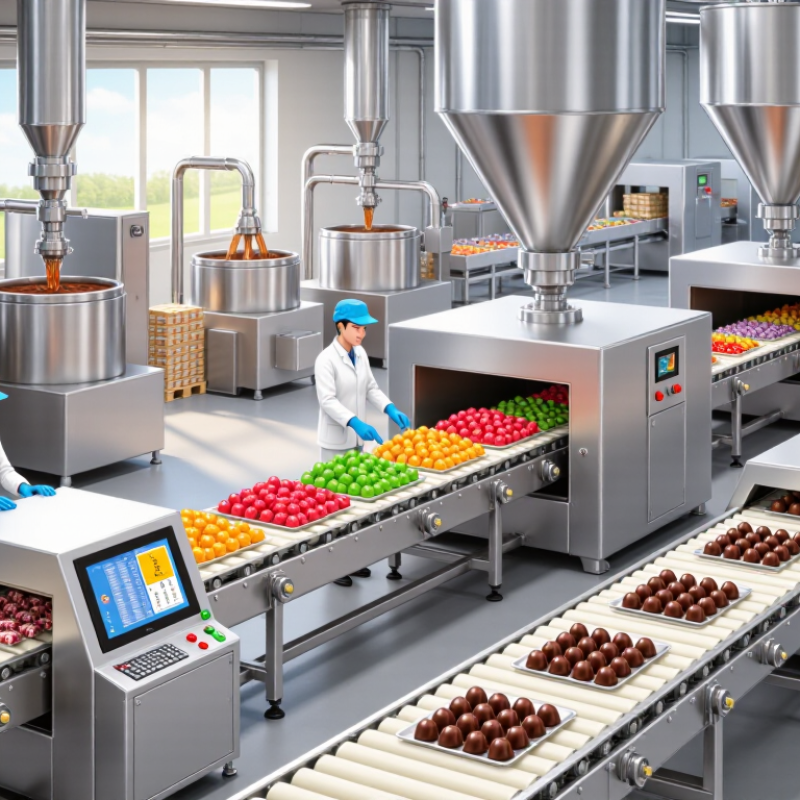
A useful comparison of China’s top candy machine manufacturers begins with a clear equipment scope. Candy production can involve cooking kettles, depositors, forming machines, cooling tunnels, and coating systems. Some factories sell complete production lines; others supply only individual machines. These differences affect what a buyer should compare, including output capacity, product dimensions, cleaning access, and control-system details. A line making gummy pieces is not automatically comparable to one producing hard candy.

HS 843820 covers machinery used to manufacture confectionery, cocoa, or chocolate. It can help buyers review trade activity, but it is not a candy-only category. Customs records may include equipment for chocolate or other confectionery products, and national tariff extensions may add further detail. Parts, packaging machines, and complete processing lines may also be classified differently, depending on the goods and local customs assessment. Trade totals therefore show declared shipments under a code, not a verified ranking of manufacturers or a measure of machine quality. Check carefully. Product descriptions and shipment records can be incomplete, so treat the data as a screening tool rather than proof of supplier capability.

Tips: Compare trade data with technical specifications, factory audits, and sample-product tests. Confirm the machine’s intended product, rated capacity, and included modules before comparing quotations. Small details matter. A cooling tunnel’s usable length, for example, can change the practical line speed.

Rank China’s Top 10 by Capacity (kg/h), Line Speed, and Export Reach

A useful ranking of China’s top ten candy machine manufacturers should compare verified production capacity, line speed, and export reach—not brochure claims alone. Capacity in kg/h depends on the recipe, candy size, and cooling time. Ask suppliers to state the product and operating conditions behind each figure. A line rated at 500 kg/h may deliver less when frequent flavor changes slow production. Small details matter.

Line speed should be checked against the full process, from cooking and forming to cooling and packaging. Request a trial using your target candy, then record output, rejects, and changeover time.

Export reach is more than the number of countries served. Compare documented installations, commissioning support, spare-parts access, and response times across your destination region. A ranking based on these records is more useful than one based on factory size. It still has limits: public data can be incomplete, and operating results vary by plant.

Tips: Request a recent production report and a written capacity guarantee for your product. Check whether the quoted speed includes cooling and packaging. If figures cannot be verified, mark them as unconfirmed rather than treating them as equal.

Compare Depositing, Molding, Cooling, and Wrapping Technologies

Choosing candy machinery starts with product behavior, not catalogue speed. For deposited gummies, chocolate centers, or hard-candy drops, check how accurately a depositor controls portion size and temperature. Uneven flow can leave tails, bubbles, or inconsistent weights. Ask for a trial using your actual recipe. Small differences matter.

Molding systems differ in cavity design, release method, and changeover time. Check whether operators can clean molds easily and whether the equipment handles your planned shapes. Cooling capacity should match real production needs, not just advertised peak output. A short cooling tunnel may leave pieces sticky or warped when room conditions change. Humidity matters too.

Wrapping equipment must suit the candy’s shape, surface, and packaging material. Compare seal consistency, film waste, and access for clearing jams. Watch a full run, including startup and product changeover; demonstrations can look smoother than production. No machine wins every product. This comparison has limits: recipes, staffing, and maintenance habits affect results. Record trial data, then weigh output against cleaning time and service access. A fast line can still disappoint.

Verify Food-Contact Compliance: EU 1935/2004, FDA 21 CFR, and EN 1672-2

When comparing candy machine manufacturers in China, treat food-contact compliance as a document-and-design check, not a logo on a brochure. EU Regulation 1935/2004 sets a general requirement: materials must not transfer substances to food in amounts that could endanger health or change its composition or taste. Ask which parts contact candy directly, such as hopper walls, belts, nozzles, and seals. Then request material specifications, traceability records, and relevant migration-test reports for the intended use.

For US-bound equipment, FDA 21 CFR requirements depend on the substance and its conditions of use; “FDA compliant” alone is too vague. Check the cited regulation, food type, temperature, and contact duration. EN 1672-2 addresses hygienic design of food-processing machinery, including cleanability and avoiding contamination traps. It is not a substitute for proving that each food-contact material meets applicable requirements. Look closely at welds, hollow frames, and fasteners near product zones. Small gaps can retain sugar syrup.

A tidy certificate folder is not enough. Not by itself. Match documents to the machine’s actual bill of materials, and confirm whether replacement parts use the same materials. Ask how the equipment drains after washdown and whether cleaning instructions cover belts and removable guards. Requirements vary by market and application, so have qualified compliance staff review the evidence before purchase. Even a careful supplier can miss a changed seal or coating; that detail deserves a second check.

China Top 10 Candy Machine Manufacturers for Global Buyers

Verify Food-Contact Compliance: EU 1935/2004, FDA 21 CFR, and EN 1672-2

This simplified scope map shows the primary role each reference plays in a buyer’s compliance review. A value of 1 indicates that the reference addresses that area; it is not a certification, compliance score, or product pass/fail result.

EU Regulation 1935/2004 sets general requirements for materials and articles intended to contact food. Relevant FDA 21 CFR provisions cover food-contact substances and food-equipment requirements, including 21 CFR 117.40. EN 1672-2 addresses hygiene requirements for food-processing machinery. Confirm applicable requirements for the machine, materials, intended use, and destination market.

Assess Total Cost Using Energy (kWh/t), Yield, Lead Time, and Service Metrics

When comparing candy machine manufacturers, ask for energy use in kWh per tonne under a defined product and production rate. A figure from a light, steady run may not reflect a sticky batch or frequent starts. Request the test conditions, including heating settings, line speed, and idle time. That number matters. Compare machines using the same recipe and operating hours, then estimate annual energy cost with your local tariff.

Yield deserves equal attention. Ask how the supplier defines saleable output and records scraps, rejects, and start-up losses. A small reduction in unusable product can outweigh modest energy savings over a year. Ask for proof. Review a sample production report, not only a brochure figure. Lead time also needs detail: confirm whether it includes factory testing, packing, shipping, installation, and operator training. Not always. A short quoted lead time may exclude critical steps.

Service quality is harder to score, but buyers can request measurable terms: response hours, spare-part dispatch time, remote troubleshooting access, and technician availability. Check what support costs after the warranty period. Keep this realistic. A spreadsheet can still hide assumptions, and I would not treat every promised metric as guaranteed performance. Put agreed test procedures and service targets in writing, then have the supplier explain how performance will be tracked after installation.

China Top 10 Candy Machine Manufacturers for Global Buyers — Assess Total Cost Using Energy (kWh/t), Yield, Lead Time, and Service Metrics

Data status: The anonymized rows below are illustrative screening scenarios, not verified measurements, quotations, or rankings of actual manufacturers. Request comparable, product-specific test data and written commercial terms from each supplier before making a decision.

Evaluation Profile Typical Equipment Scope Planning Capacity
(kg/h)
Energy Use
(kWh/t)
Saleable Product Yield
(%)
Indicative Build Lead Time
(weeks)
Remote Support Response
(business hours)
Warranty Planning Assumption Buyer Checks Before Comparing
Profile 01 Hard-candy cooking and depositing line 300–500 180–260 95.0–97.0 12–18 8–24 12 months from shipment or commissioning, subject to contract Confirm whether the energy figure includes cooking, forming, cooling, and compressed air.
Profile 02 Hard-candy forming line with batch cooking 150–300 200–300 94.0–96.5 10–16 8–24 12 months from shipment or commissioning, subject to contract Check changeover losses, start-up scrap, and whether capacity is based on a specified candy size.
Profile 03 Toffee or caramel cooking and forming line 200–400 220–330 93.0–96.0 14–20 8–24 12 months from shipment or commissioning, subject to contract Specify recipe, moisture target, cooking method, and cleaning requirements for the yield trial.
Profile 04 Gummy cooking, depositing, and cooling line 250–500 250–380 92.0–96.0 16–24 8–24 12 months from shipment or commissioning, subject to contract Define whether drying or conditioning rooms and their utilities are included in the energy boundary.
Profile 05 Chocolate enrobing and cooling line 300–700 150–280 96.0–98.5 12–20 8–24 12 months from shipment or commissioning, subject to contract Compare at the same product width, coating percentage, cooling conditions, and operating speed.
Profile 06 Chocolate molding and cooling line 200–600 180–320 95.0–98.0 14–22 8–24 12 months from shipment or commissioning, subject to contract Check tempering, cooling, mold handling, and packaging interfaces included in the quoted scope.
Profile 07 Center-filled candy depositing line 200–450 220–340 92.0–96.0 16–24 8–24 12 months from shipment or commissioning, subject to contract Validate filling accuracy, reject rate, and yield using the buyer’s actual filling material.
Profile 08 Chewing-gum mixing, extrusion, and forming line 150–350 200–350 93.0–97.0 16–26 8–24 12 months from shipment or commissioning, subject to contract Ask for sustained-run output and scrap data for the target gum base, format, and coating process.
Profile 09 Jelly or pectin candy cooking and depositing line 200–450 230–360 92.0–96.0 14–22 8–24 12 months from shipment or commissioning, subject to contract Record cooking energy, drying or conditioning time, and conforming output over a defined test period.
Profile 10 Small-batch or flexible multi-product candy line 50–200 250–450 88.0–95.0 8–16 8–24 12 months from shipment or commissioning, subject to contract Include recipe changeovers, cleaning, operator labor, and low-volume production losses in the cost model.